ESG Data Center
For a bountiful future for all humanities,
Korea Zinc refines today and prepares for tomorrow.
Environment
Scope1
2.63M tCO2eq
Scope2
0.62M tCO2eq
Scope3
2.93M tCO2eq
Energy Consumption
44,204TJ
Renewable Energy Consumption
0.64TJ
NOx
540.3ton
SOx
694.8ton
TSP
82.9ton
TOC
16.8ton
SS
38.5ton
BOD
3.8ton
T-N
107.3ton
T-P
0.44ton
Environmental Management System
The Onsan Refinery, first acquired ISO 14001 certification in 2015. This certification, which serves as the international standard for environmental management systems, has been maintained through regular renewals. The refinery undergoes annual audits by accredited third-party institutions to assess and improve its environmental management system, ensuring its continued effectiveness.
| Metric | Site | Employee |
|---|---|---|
| Total Number | 2 (Headquaters, Onsan Refinery) | 2,089 |
| Number certified to ISO 14001 | 1 (Onsan Refinery) | 1,795 |
| Proportion | 50% | 86% |
Net Zero Scenario
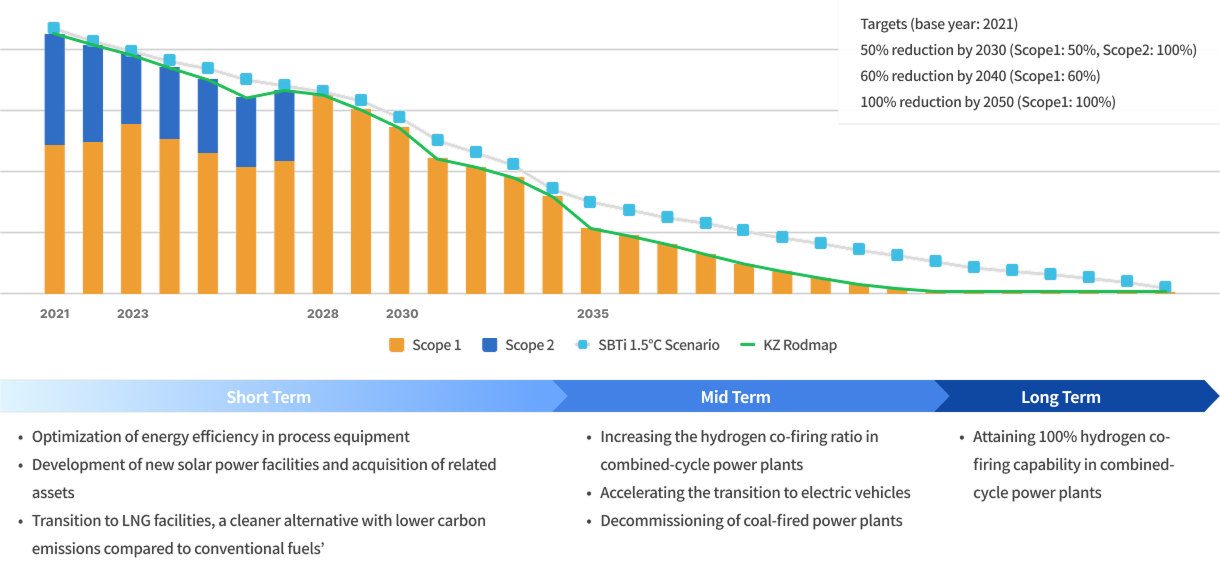
Korea Zinc reported our “Carbon Reduction Plan” during the regular board meeting held on November 8, 2024, and the agenda for this meeting is accessible on our website.
Fleet Fuel Carbon Emission and
Energy Usage
| Metric | 2025 |
|---|---|
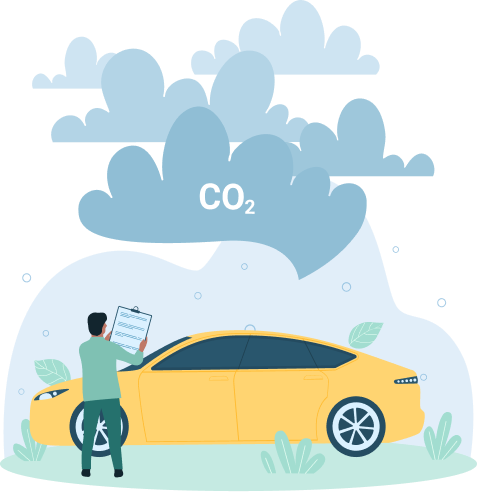
| Carbon Emission (tCO₂eq) | 516 |
| Energy Usage (MJ) | 7,558,337 |
Energy Usage of
Hydrogen Forklift
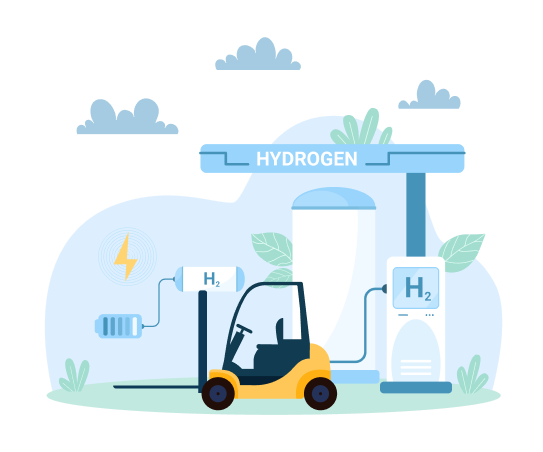
As part of its efforts to lead carbon emissions reduction, Korea Zinc established Korea’s first hydrogen fueling station dedicated to hydrogen-powered forklifts within a national industrial complex at its Onsan Refinery in Ulsan in 2024. Since 2024, the Company has been replacing diesel-powered forklifts with hydrogen-powered models and aims to deploy a total of 30 hydrogen-powered forklifts.
| Metric | 2025 |
|---|---|
| Hydrogen (m³) | 8,270 |
| Electricity (kWh) | 89,191 |
Investment in Energy Conservation & Saving from energy Conservation programs
Korea Zinc has consistently made energy-saving investments each year. In 2025, it invested approximately KRW 14.6 billion in energy-saving activities.
| No. | Energy Conservation Program | Duration | Investment (milion KRW) |
|---|---|---|---|
| 1 | Electricity savings through the installation of high-efficiency cooling-tower fans | Aug. 2024 – Mar. 2025 | 610 |
| 2 | Electricity savings by replacing aging air compressors with a high-efficiency, high-capacity system | Sep. 2024 – Jun. 2025 | 6,204 |
| 3 | Energy-use optimization by introducing an advanced energymonitoring system | Oct. 2024 – May 2025 | 523 |
| 4 | LNG-consumption reduction by recycling exhaust-gas waste heat | Dec. 2024 – Jul. 2025 | 599 |
| 5 | Energy-use efficiency improvement by increasing hot-water utilization | Jul. 2025 – Dec. 2026 | 6,438 |
| 6 | Installation of a scale remover for cooling-tower cooling water | Nov. 2025 – Mar. 2026 | 207 |
| Total | 14,581 | ||
Water Resource Risk Management
Korea Zinc recognizes water consumption and water scarcity as critical global trends that require close monitoring. The company conducts an annual water risk assessment of its facilities using the WRI Aqueduct tool, which evaluates risks under short-, medium-, and long-term climate scenarios. Based on the results of this assessment, none of the sites operated by the company are located in regions categorized as areas facing high or extremely high water stress.
| Metric | Unit | 2025 |
|---|---|---|
| Freshwater withdrawn | m3 | 16,586,646 |
| Percentage of fresh water withdrawn in regions with High or Extremely High Baseline Water Stress | Percentage(%) | 0 |
| Water reuse | m3 | 1,012,547 |
-

Biodiversity
This is not applicable, as the Company operates from sites located in a National Industrial Complex, far from ecologically sensitive regions. Nevertheless, the Company has established a Biodiversity Conservation Policy and actively implements initiatives to conserve and protect biodiversity. For further details, please refer to pages 49–56 of this Sustainability Report.
-
Disturbed Land
Korea Zinc operates within government-regulated National Industrial Complex, ensuring compliance with all land use and environmental regulations. The company employs Top Submerged Lance (TSL) technology, which efficiently recycles waste materials to maximize zinc recovery. This process eliminates the need for waste ponds, as residues are processed to extract valuable metals, resulting in minimal environmental disturbance.
-

Spill
Korea Zinc reported zero spills at its operational sites in both 2023 and 2024. This achievement is supported by the company’s robust chemical substance management practices, which are disclosed on page 31 of the Sustainability Report.
Social
Employee
| Number of employees | Permanent employees | Number of female employees | Percentage of female manager | New Hires |
|---|---|---|---|---|
| 2,089 | 1,936 | 132 | 8.71 % | 211 |
Diversity Metric
The total number of employees with diverse national backgrounds is six, consisting of five in Senior Management and one in Junior Management.
| Metric | Unit | 2025 | Note |
|---|---|---|---|
| Management position | No. of people | 5 | Includes 3 Australians and 2 U.S. nationals |
| Junior management position | No. of people | 1 | Includes 1 U.S. national |
Annual Average Education Hours Categorized by Gender
| Metric | Male | Female | Total |
|---|---|---|---|
| Accumulated hours | 115,847 | 6,468 | 122,315 |
| No. of employee | 1,957 | 132 | 2,089 |
| Per capita hours | 59 | 49 | 59 |
Annual Average Education Hours by Employee Category
| Metric | Managerial position | Non-managerial position | Total |
|---|---|---|---|
| Accumulated hours | 9,176 | 113,139 | 122,315 |
| No. of employee | 124 | 1,965 | 2,089 |
| Per capita hours | 74 | 58 | 59 |
Promotion on mental health awareness
The company conducts an annual mental health assessment for all employees, including contractors working at operational sites. In 2024, the assessment took place from May 8th to June 28th, evaluating 43 key factors. These factors encompassed the physical work environment, interpersonal conflicts, corporate culture, work-related stress, and the level of autonomy employees have in their roles. Participants identified as experiencing high stress levels were provided with one-on-one counseling sessions, along with the option for more in-depth support if required. Additionally, employees who displayed healthy mental well-being received online educational materials to help sustain and enhance their mental resilience. Furthermore, the company provides all employees with access to free consultation programs each year to support both job satisfaction and emotional well-being.
Product Safety
Korea Zinc produces a diverse portfolio of metals, ranging from base metals to precious and minor metals. The company utilizes a variety of metallurgical processes to extract target metals from different raw materials and efficiently remove impurities, resulting in high-purity products.
The company’s products are registered with the London Metal Exchange (LME) and the London Bullion Market Association (LBMA), demonstrating alignment with internationally recognized quality standards.
Human Resource Management
Korea Zinc enhances its competitiveness by strengthening employees’ leadership and job-related competencies and providing language training. We also regularly assess employees’ training needs and conduct satisfaction surveys and training evaluations to support their career development and enhance their performance. In addition, to create an efficient working environment and support work-life balance, Korea Zinc has enhanced its working hours and attendance management system and implemented a PC-OFF system. Through these initiatives, the Company aims to systematically manage working hours and foster a healthy work culture for its employees.
Supply Chain ESG Assessment
Korea Zinc conducts annual ESG assessments of selected key suppliers, reflecting its Supplier Code of Conduct as well as relevant domestic and international requirements, and covering environmental protection and other related ESG topics. These assessments are designed to systematically and comprehensively review whether suppliers meet the Company’s standards and expectations. In 2025, ESG assessments were conducted for key suppliers, and among the assessed suppliers, 10 were selected for additional on-site ESG assessments to more thoroughly review their compliance across ESG topics. As a result of the on-site ESG assessments, no material environmental impacts were identified (0 cases). In addition, to support the enhancement of ESG capabilities among the assessed suppliers, Korea Zinc prepares and provides company-specific diagnostic reports analyzing each supplier’s ESG performance level.
Governance
ESG Committee
Since 2022, Korea Zinc has operated the Sustainability Management Committee as an advisory body to the CEO. On December 23, 2024, we elevated it to the ESG Committee, a committee under the Board as defined by the Commercial Act, and simultaneously established the Sustainability Promotion Committee, as its implementation body. The ESG Committee is positioned as the core decision-making body for ESG management, overseeing the overall direction, performance and major issues of sustainable management across environmental, social and governance sectors.
| Session | Date | No. of Member | Committee Attendance |
|---|---|---|---|
| 1st | 25 Feb | 3 | 100%(3/3) |
| 2nd | 16 Jul | 3 | 100%(3/3) |
| 3rd | 21 Nov | 4 | 100%(4/4) |
Sustainability Steering Committee
The Sustainability Steering Committee was established in February 2025 to succeed and expand upon the role of the Sustainability Management Committee, which had been in operation since 2022. With the launch of the ESG Committee under the Board in December 2024, the Sustainability Steering Committee also assumed responsibility for reviewing agenda items to be submitted to the ESG Committee. With an aim to enhance its expertise, the committee appointed external advisors specializing in environmental, social, and governance area at its inaugural meeting in February 2025.
| Session | Date | No. of Member | Committee Attendance |
|---|---|---|---|
| 1st | 25.02.20 | 12 | 92%(11/12) |
| 2nd | 25.04.30 | 12 | 92%(11/12) |
| 3rd | 25.10.02 | 13 | 100%(13/13) |
Code of Business Ethics
Korea Zinc conducts annual ethics management training, including anti-corruption programs, for all employees, members of the Board, and contract workers. Based on the Code of Ethics, all employees are also required to submit an annual ethical management pledge to reaffirm their understanding and commitment to ethical conduct.